
Riichi mahjong scoring may look complicated at first, but here’s the truth:
you don’t need to learn any difficult formulas to score correctly.
If you can count your han and fu, you already have everything you need.
Just check the score table — that’s it.
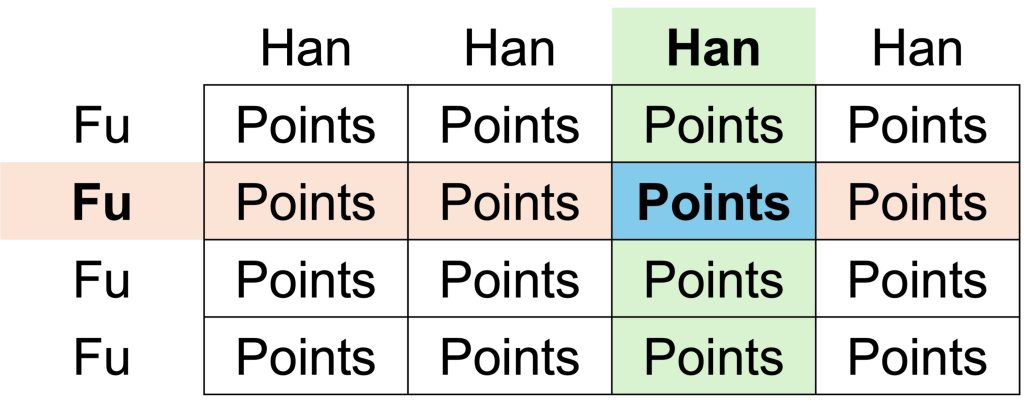
Many new players feel intimidated because scoring involves numbers, tables, dealer bonuses, and unfamiliar terms.
But once you understand the basic idea, the entire system becomes simple and predictable.
This guide explains scoring in the clearest, most beginner-friendly way possible,
so you can start playing confidently right away.
1. What Scoring Means in Riichi Mahjong
Scoring tells you how many points you win or lose at the end of each hand.
You don’t have to know every detail of the system — you just need to understand the overall structure.
Riichi mahjong uses only two values to determine hand strength:
• Han: bonuses from yaku and dora
• Fu: minipoints based on hand structure
Once you have those two numbers, the rest is simply reading a table.
The Core Idea
Han × Fu → Find the value on the score table → Done.
That’s all you need to score hands in real games.
2. Understanding Han (Yaku Bonuses)
Han is the easiest part of scoring. Most han come from yaku, the special conditions that make a hand valid.
Common one-han yaku
These appear frequently and are easy to remember:
- Riichi
- Tanyao
- Pinfu
- Yakuhai (value honor tiles)
Dora: Bonus Han
Dora tiles add extra han but do not count as yaku.
Your hand must already have at least one real yaku to win.
Just count the dora in your hand and add them to your total han.
3. Fu Basics (Minipoints Explained Simply)
Fu represents the structure of your hand.
Many guidebooks overwhelm beginners by listing every rule, but you do not need to memorize them.
The Simple Reality
Most hands end up being:
- 20 fu
- 30 fu
- 40 fu
- 50 fu
These values cover the majority of real situations.
Only Learn the Essentials First
If you are interested in understanding how fu is calculated — things like wait shape, meld type, or bonuses — you can read the simple guide here:
👉 Fu Calculation Guide (for curious players)
But remember: you don’t need fu formulas to play or score correctly.
Just take the fu your hand is given and continue.
4. How to Count Your Points
Here is the entire scoring process in three steps:
Step 1: Identify your yaku
Does your hand have riichi, tanyao, pinfu, yakuhai, or something else? Count the han.
Step 2: Add dora
Red fives, dora indicators, kan dora, uradora — simply count how many dora tiles you hold.
Step 3: Combine han + fu and check the score table
Once you know your han and fu, all you need to do is check the table.
No mental math required.
5. Limit Hands Make Scoring Even Easier
A big secret of riichi mahjong scoring is that strong hands are actually the easiest to score.
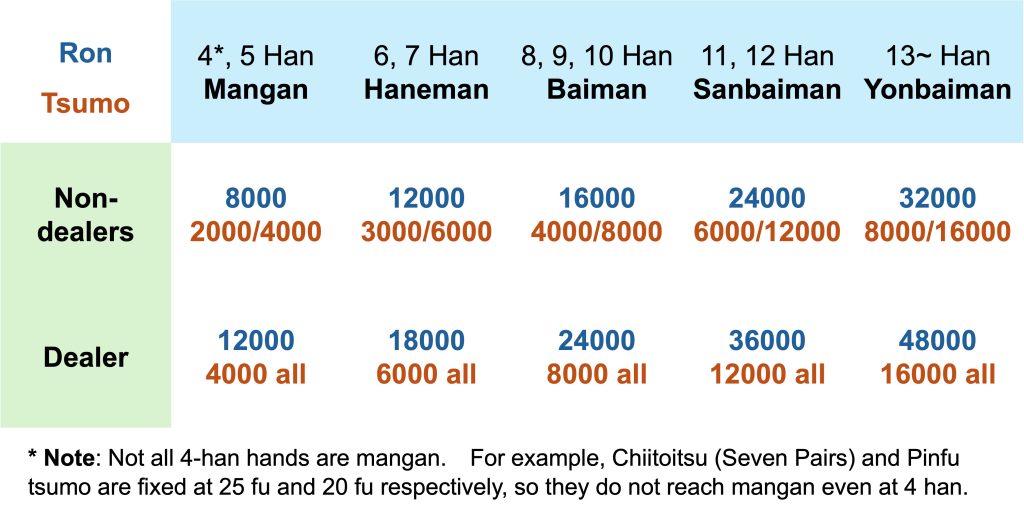
If your hand reaches 5 han, it becomes a limit hand (mangan).
At that point:
- Fu no longer matters
- scoring becomes automatic
Higher limit tiers (haneman, baiman, sanbaiman, yakuman) follow the same idea:
once han is high enough, scoring is simple.
6. How to Read a Riichi Mahjong Score Table
The score table converts your han and fu into actual points for ron or tsumo.
You will use only a few parts of the table repeatedly.
Dealer vs Non-dealer
• Dealer wins more and pays more
• Dealer values are always 1.5× non-dealer values
Ron vs Tsumos
• Ron → one player pays everything
• Tsumo (non-dealer) → dealer pays more
• Tsumo (dealer) → everyone pays equally
You will use the same rows over and over
In practice, you repeatedly check:
• 30 fu 1 han
• 30 fu 2 han
• 40 fu 2 han
• 40 fu 3 han
• 50 fu 2 han
That’s it. The table is much smaller than it looks.
7. Scoring Examples You Should Know
Example 1: 40 fu 3 han (Menzen Ron)
One of the most common scoring patterns:
• Non-dealer ron → 5200
• Dealer ron → 7700
Example 2: 30 fu 2 han (Non-dealer Tsumo)
• Tsumo → 400 / 700
The dealer pays the larger portion.
Example 3: 40 fu 2 han (Dealer)
• Ron → 3900
• Tsumo → 1300 all
8. Common Mistakes and Helpful Tips
1. Forgetting to round fu upward
Fu always rounds up to the nearest 10.
2. Miscounting dora
Beginner hands often include red fives that new players forget to count.
3. Not knowing dealer bonuses
Dealer value is always higher — this matters a lot in scoring and strategy.
4. Aim for mangan when close
If your hand is almost mangan, fu doesn’t matter.
You should focus on speed and winning.
9. Practice Problems
If you’d like to test yourself with real scoring questions, try these:
👉 Scoring Practice Problems