
Understanding the flow of a riichi mahjong game is much easier once you can see the whole structure.
A hanchan is built from a series of rounds, and each round is made up of individual hands.
If you know how a hand begins, how turns progress, and how a hand ends, the entire game becomes surprisingly simple.
In this guide, we’ll walk through the three essential layers of game flow:
- The initial setup — how players sit, how the wall is built, and how tiles are dealt
- The structure of a hanchan — how dealer rotation, honba, and riichi sticks shape the overall game
- The structure of a hand — draw and discard rhythm, calls, wins, and draws
All explanations follow the WRC 2025 rules, which provide a clean and modern standard for riichi mahjong.
Later, we’ll also highlight how these rules differ from common Japanese rules, so you can understand both the international standard and the practices used in Japan.
Let’s begin by looking at how a riichi mahjong game is set up.
1. Setup
1.1 Seating and Turn Order
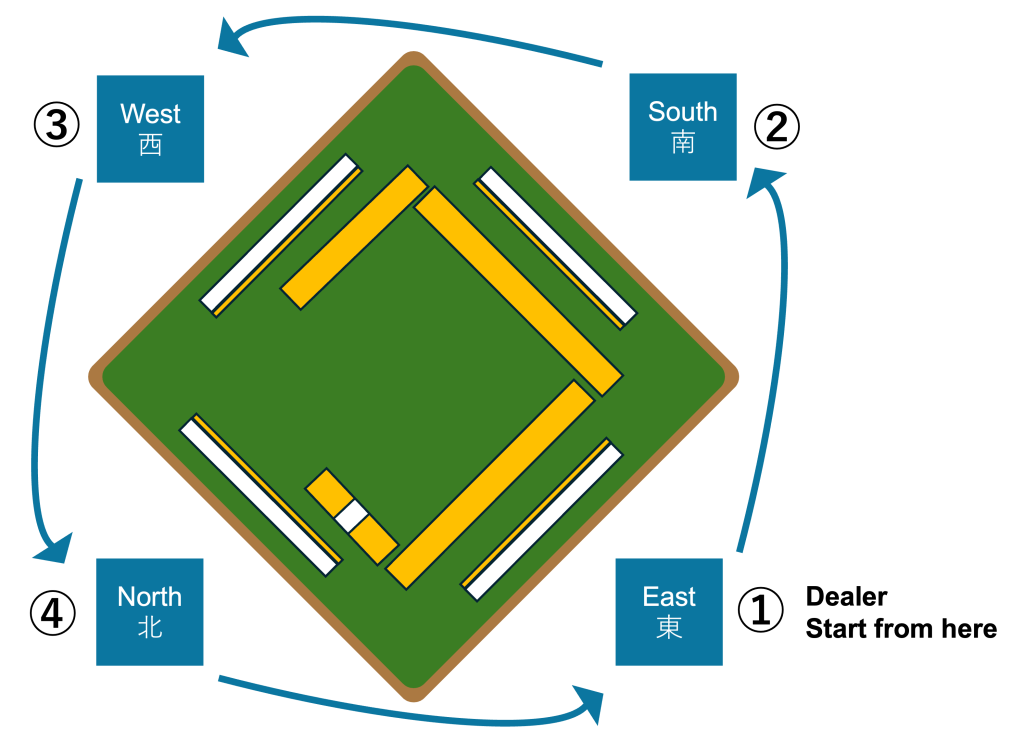
Riichi mahjong is played by four players seated counter-clockwise in the order
East → South → West → North.
The East player is the dealer, and the hand always begins with East’s first discard.
Turn order also proceeds counter-clockwise.
1.2 Starting Points
Each player starts the hanchan with 30,000 points.
All scoring changes during the game are added to or subtracted from this amount.
1.3 Building the Wall (Manual Play)
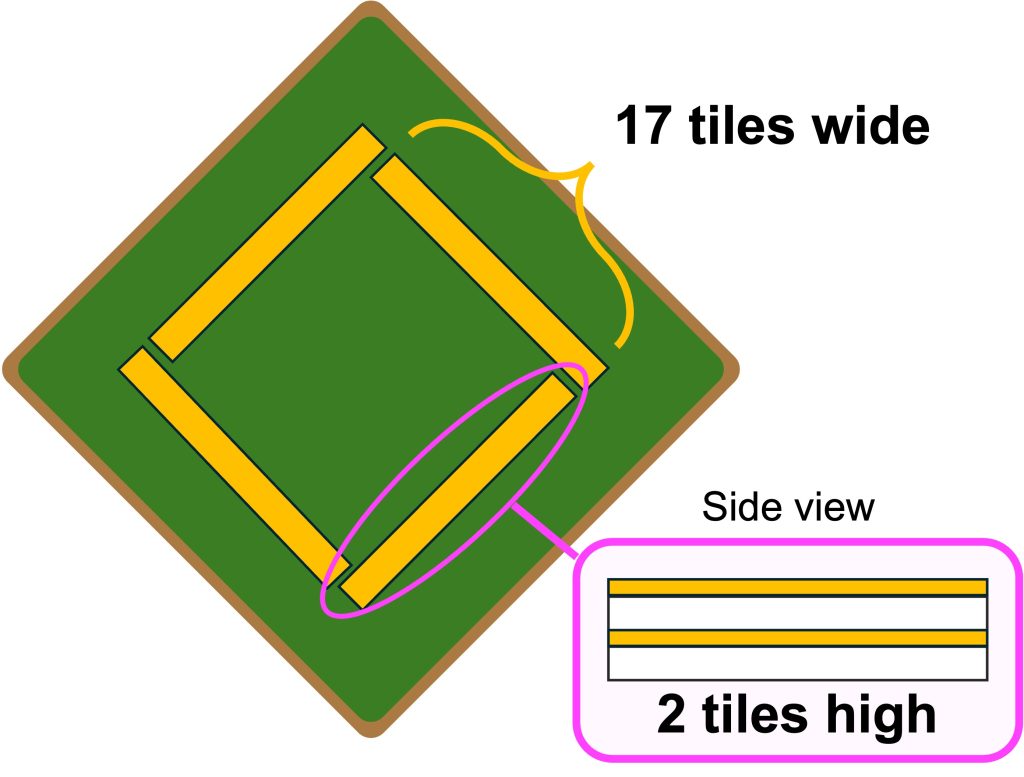
When playing without an automatic table, players shuffle all 136 tiles and build a wall in front of themselves:
- 17 stacks wide × 2 tiles high, forming a square of four walls.
1.4 Dice Roll, Dora Indicator, and Dealing Tiles
The East player rolls two dice to determine where the wall is opened.
Tiles are then dealt in this order:
- East begins with 14 tiles
- All other players begin with 13 tiles
The top tile of the third stack from the end of the dead wall is flipped as the dora indicator.
The actual dora is the next tile in sequence (e.g., indicator = 5p → dora = 6p).
1.5 The 14/13 Tile Rule
During your turn, you must hold 14 tiles.
After discarding, your hand must return to 13 tiles.
Only the dealer’s first turn begins with 14 tiles, so they discard without drawing.
This “draw to 14 → discard to 13” rhythm is the core of the game’s flow.
2. Structure of a Hanchan
2.1 What a Hanchan Consists Of
A hanchan consists of the East round and the South round.
Each player becomes dealer twice.
WRC rules do not include a West round.
2.2 When the Dealer Continues or Rotates
The dealer (East) continues when:
- East wins the hand, or
- The hand ends in an exhaustive draw and East is in tenpai
The dealer rotates to the next player when:
- Another player wins, or
- The hand ends in a draw and East is noten
This means a hanchan does not always end in exactly 8 hands — dealer continuations extend the round.
2.3 Honba Counters
Honba counters represent consecutive dealer continuations.
Each honba adds:
- +100 points per opponent on a tsumo win
- +300 points (from the discarder) on a ron win
Honba counters carry over until a non-dealer win resets them.
2.4 Riichi Sticks
Declaring riichi requires placing a 1,000-point stick in the center of the table.
Riichi stick rules:
- If a player wins, that player collects all riichi sticks.
- If the hand ends in a draw, riichi sticks carry over to the next hand.
Special Case: End of the Final Hand
If the hanchan ends (for example, in South 4) and riichi sticks remain on the table:
- Nobody receives them.
- They simply remain unclaimed under WRC rules.
2.5 No Agari-yame
WRC does not allow ending the game early by winning the final hand while ahead.
Gameplay ends only once the South round finishes or the time limit closes the hanchan.
3. Structure of a Hand
3.1 Basic Turn Flow
A hand begins when East discards their first tile.
Each turn follows this pattern:
- Draw a tile (or call a discard)
- Optionally declare pon / chi / kan / riichi / win
- Discard a tile
Play continues counter-clockwise.
3.2 Calls and Melds
Pon
Claim a discard to form a triplet.
Can be called from any opponent.
Chi
Claim the left-hand opponent’s discard to form a sequence.
Only the player to your left may be chii-called.
Kan
There are three types:
- Closed Kan (Ankan) – four identical tiles from your hand
- Open Kan (Daiminkan) – using another player’s discard
- Added Kan (Kakan) – adding a tile to an existing pon
If a player attempts kakan and another player could win on that tile,
the win is called Robbing the Kan (Chankan).
3.3 Riichi and Post-Riichi Restrictions
A closed tenpai hand may declare riichi.
After declaring riichi, the player must:
- Keep their hand structure locked
- Discard every tile they draw without rearranging the hand
- Avoid pon, chi, or open kan
Only closed kans may be declared, and only if doing so does not change the hand’s wait or structure
Note: The full conditions for closed kans after riichi are complex under WRC rules.
A separate article will cover these details.
3.4 Discards as Open Information
Discards are placed face-up in ordered rows so all players can see them.
This information determines:
- Call eligibility
- Furiten
- Reading opponents
- Safety assessment
3.5 How a Hand Ends
1. A Player Wins
- Ron: winning on another player’s discard
- Tsumo: winning on your own draw
Only one winner is allowed under WRC precedence rules.
2. Exhaustive Draw
A hand ends in a draw when:
- The final tile of the live wall is drawn and discarded, and
- No player wins on that discard
3.6 Tenpai Declarations and Payments
At an exhaustive draw:
- Players declare tenpai or noten
- Riichi players must reveal their hands
- Other players may reveal or keep their hands hidden
A total of 3,000 points is exchanged:
- Noten players pay
- Tenpai players receive
- The points are divided according to the number of players in each group